Demos
Demos  Colors
 Docs
Docs  Support
Home 15
Newly Added



Running a business involves much more than generating sales and managing operations. Behind every successful company is a strong financial system that keeps records accurate, organized, and ready for review at any time. Many businesses underestimate the importance of maintaining proper financial records until they face penalties, tax problems, or legal complications caused by missing or inaccurate documentation.
Organized financial records are not just helpful for internal management. They play a critical role in maintaining compliance with tax laws, financial regulations, payroll requirements, and reporting standards. Businesses that prioritize accurate bookkeeping and financial organization are far less likely to encounter compliance issues that can disrupt operations and damage credibility.
Financial compliance refers to following the legal and regulatory requirements related to accounting, taxation, payroll, reporting, and business transactions. Government agencies expect businesses to maintain accurate records that clearly reflect income, expenses, taxes, employee payments, and other financial activities.
When records are incomplete or disorganized, businesses may struggle to provide the information required during tax filings, audits, or financial reviews. This can lead to penalties, delayed filings, fines, and unnecessary stress for business owners.
Compliance is not only about avoiding legal trouble. It also helps businesses build trust with clients, investors, financial institutions, and regulatory authorities.
One of the biggest causes of compliance problems is inaccurate financial reporting. Small mistakes in bookkeeping can eventually create larger issues during tax season or financial audits.
Organized financial records help businesses track every transaction properly, reducing the risk of missing invoices, duplicate entries, incorrect expense classifications, or reporting inconsistencies. When financial data is updated regularly and stored systematically, it becomes much easier to identify and correct errors before they become serious problems.
Consistent recordkeeping also ensures that businesses always have reliable financial information available for decision-making and reporting purposes.
Tax regulations can be complex, especially for growing businesses handling multiple income sources, expenses, payroll obligations, and vendor payments. Disorganized records often result in delayed tax preparation, inaccurate filings, or overlooked deductions.
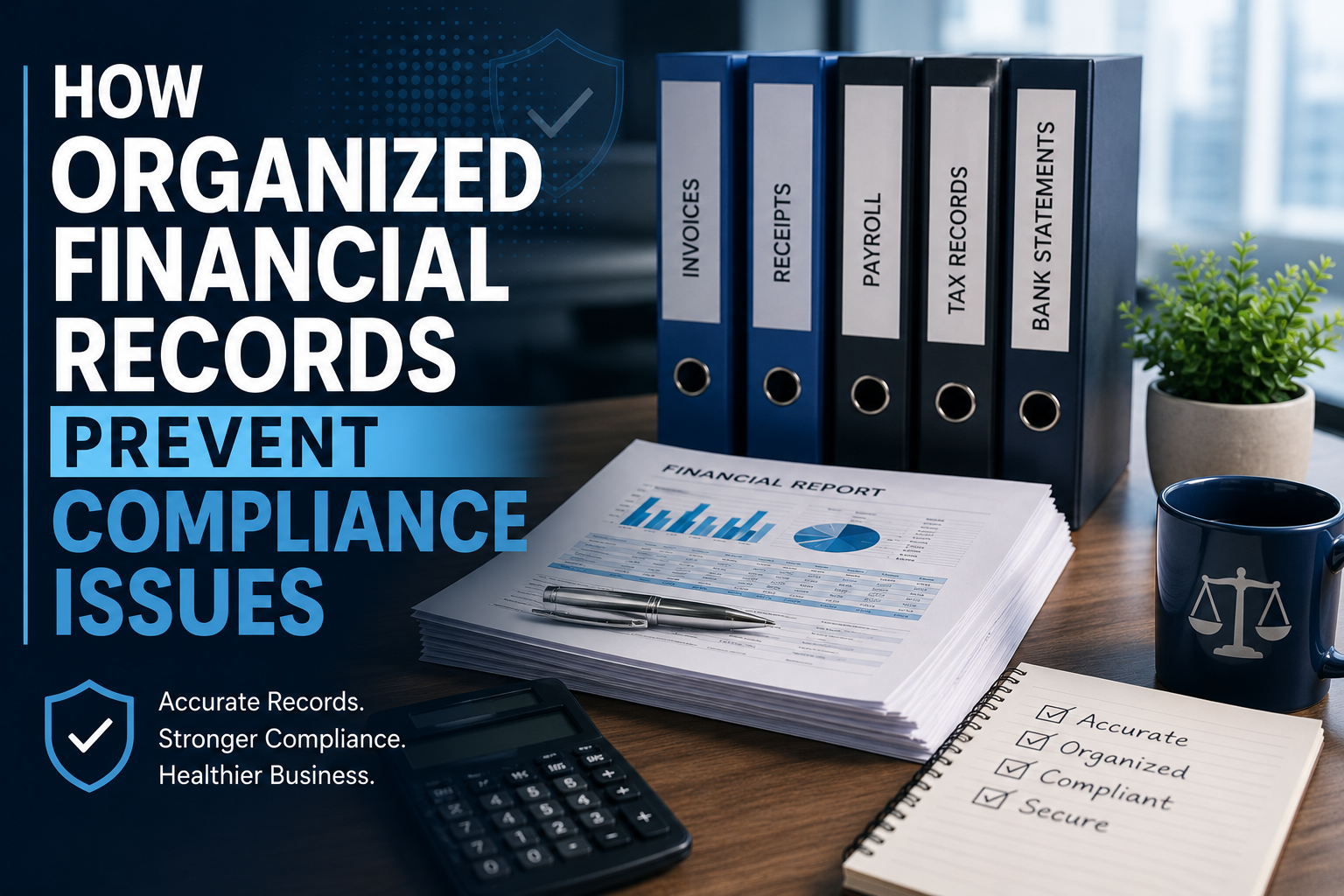
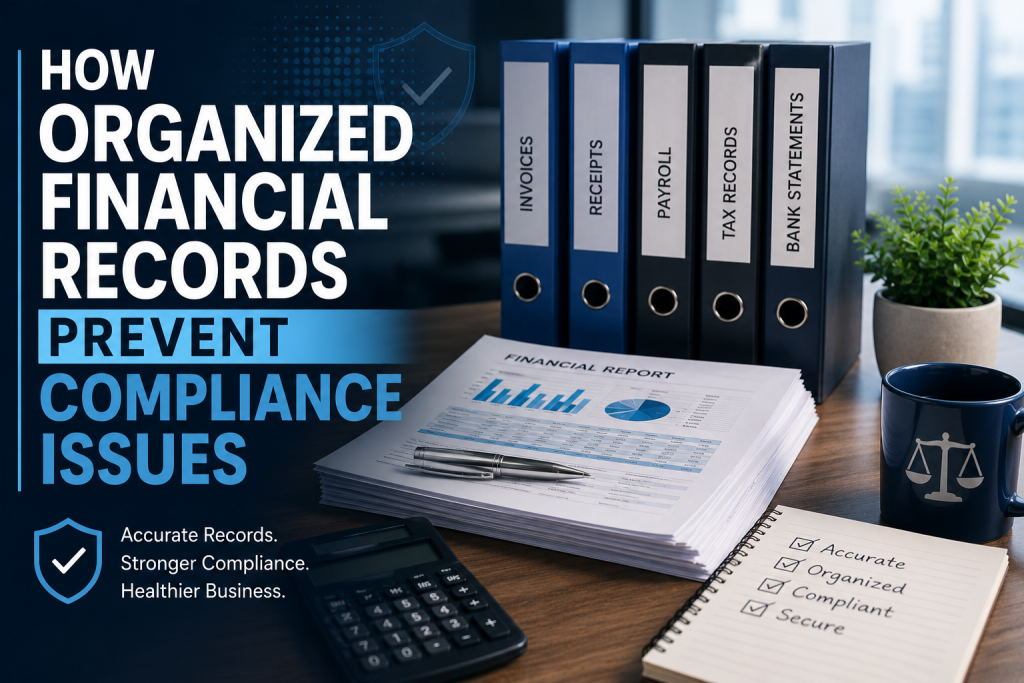
Maintaining organized financial records allows businesses to prepare taxes more efficiently and accurately. Important documents such as receipts, invoices, payroll records, bank statements, and expense reports remain easily accessible whenever needed.
This level of organization reduces the chances of filing errors and helps businesses respond quickly if tax authorities request additional information or clarification.
Businesses with strong bookkeeping systems are also better prepared to meet deadlines, which helps avoid late filing penalties and unnecessary financial stress.
Audits can be intimidating for businesses that do not maintain proper financial documentation. Missing records, inconsistent reports, or unclear transactions can create complications that extend the audit process and increase scrutiny.
Organized financial records simplify the audit process significantly. When every transaction is documented and categorized properly, auditors can review information more efficiently. Businesses can provide requested documents quickly, which creates a stronger impression of professionalism and financial responsibility.
Even businesses that are not currently facing audits benefit from maintaining audit-ready records because it ensures long-term financial transparency and accountability.
Payroll compliance is another area where organized financial records are extremely important. Businesses are required to maintain accurate employee payment records, tax withholdings, benefits information, and payroll documentation.
Poor payroll management can lead to serious compliance issues, including employee disputes, tax penalties, and reporting errors. Organized payroll records help businesses ensure employees are paid correctly and tax obligations are handled properly.
Accurate documentation also becomes valuable when businesses need to verify employment details, respond to employee concerns, or prepare year-end reporting.
Financial organization not only helps with compliance but also improves overall business management. Businesses with clear and updated records gain better visibility into cash flow, expenses, profitability, and operational performance.
This visibility allows business owners to make informed decisions with confidence. Instead of reacting to financial problems after they occur, organized businesses can identify risks early and plan more effectively for growth.
Strong financial systems also improve communication with accountants, tax professionals, and financial advisors who rely on accurate data to provide guidance.
Modern bookkeeping technology has made financial organization more efficient than ever. Cloud-based accounting systems allow businesses to store records securely, automate transaction tracking, and generate reports in real time.
Digital bookkeeping reduces the chances of lost paperwork and improves accessibility for business owners and financial teams. Automated systems also help maintain consistency and reduce manual data entry errors that often contribute to compliance problems.
Businesses that adopt modern financial management practices are better positioned to handle regulatory changes and growing financial responsibilities.
Organized financial records are one of the most important foundations of a compliant and financially healthy business. They help prevent reporting errors, simplify tax preparation, reduce audit risks, and improve overall operational efficiency.
Many compliance problems do not happen because businesses intentionally ignore regulations. They happen because financial information is incomplete, inaccurate, or poorly managed. By maintaining clear and organized records, businesses can avoid unnecessary complications and focus more confidently on growth and long-term success.
In today’s fast-moving business environment, financial organization is no longer optional. It is an essential part of building a stable, professional, and compliant business.
How Modern Businesses Are Simplifying Financial Management In today’s fast-moving business environment, managing finances efficiently…
The real estate industry operates on complex financial structures, fluctuating cash flows, and long-term investments.…
The rise of freelancing and self employment in India has transformed how people earn and…
Running a business in today’s fast paced environment means juggling multiple responsibilities at once. From…

Error: Contact form not found.

The great explorer of the truth, the master-builder of human happiness no one rejects dislikes avoids pleasure itself because it is pleasure but because know who do not those how to pursue pleasures rationally encounter consequences that are extremely painful desires to obtain.
Read More