Demos
 Colors
 Docs
 Support






Introduction
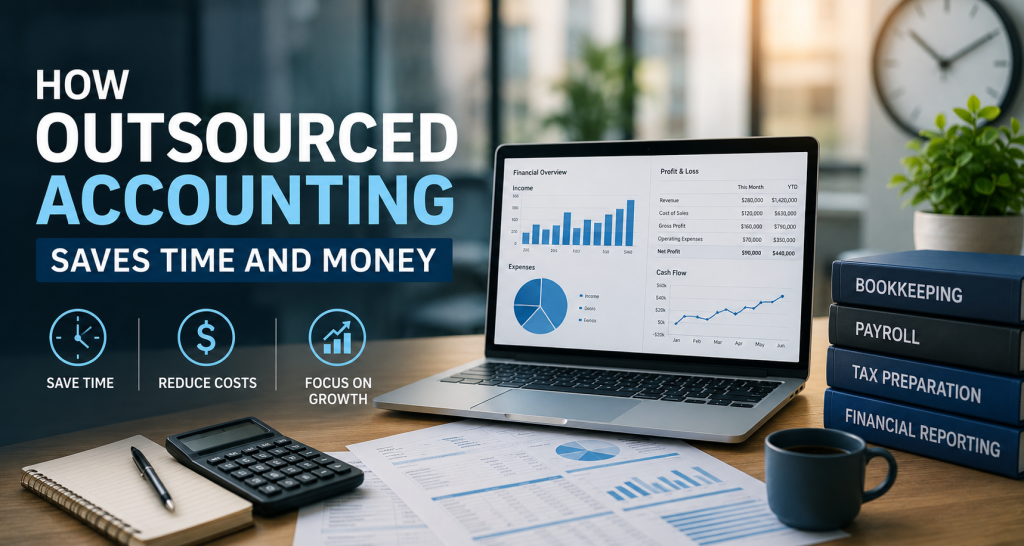
Managing business finances is one of the most important responsibilities for any organization. From recording daily transactions and processing payroll to preparing financial reports and ensuring tax compliance, accounting requires accuracy, consistency, and expertise. For many small and growing businesses, handling these responsibilities internally can become time-consuming and expensive.
As businesses expand, financial operations become more complex, leaving business owners with less time to focus on growth and customer satisfaction. This is why an increasing number of companies are turning to outsourced accounting services. Outsourcing accounting allows businesses to access professional financial expertise without the cost of maintaining a full in-house accounting department.
Beyond reducing workload, outsourced accounting can significantly improve efficiency, lower operating costs, and provide better financial insights that support long-term business success.
What Is Outsourced Accounting?
Outsourced accounting is the practice of hiring an external accounting firm or financial service provider to manage some or all of a company’s accounting functions. These services may include bookkeeping, accounts payable, accounts receivable, payroll processing, financial reporting, tax preparation, budgeting, and financial analysis.
Instead of recruiting, training, and supervising an internal accounting team, businesses gain access to experienced professionals who manage financial operations using advanced accounting software and industry best practices.
This approach allows business owners to receive accurate financial information while reducing administrative responsibilities.
Why Businesses Are Choosing Outsourced Accounting
The modern business environment demands speed, efficiency, and financial accuracy. Business owners are expected to make informed decisions quickly while adapting to changing market conditions.
Managing accounting internally often requires significant investments in salaries, employee benefits, accounting software, office space, ongoing training, and compliance updates. For small and medium-sized businesses, these expenses can place unnecessary pressure on operating budgets.
Outsourced accounting provides a cost-effective alternative by delivering professional financial support without the overhead costs associated with an internal accounting department.
Saving Time Through Professional Financial Management
Accounting involves numerous repetitive and detail-oriented tasks that consume valuable business hours. Recording transactions, reconciling bank accounts, generating invoices, managing payroll, preparing reports, and monitoring expenses all require careful attention.
When business owners attempt to manage these responsibilities themselves, they often sacrifice time that could be spent developing new products, improving customer relationships, or expanding their business.
Professional accounting teams handle these financial processes efficiently because they specialize in accounting every day. Their experience allows them to complete tasks faster while maintaining a high level of accuracy.
By outsourcing accounting functions, business owners gain more time to focus on strategic planning and revenue-generating activities.
Reducing Labor Costs
Hiring an in-house accountant involves far more than paying a monthly salary. Businesses must also consider recruitment expenses, employee benefits, payroll taxes, insurance, office equipment, training, paid leave, and software licensing costs.
As a company grows, additional accounting staff may be required, further increasing operational expenses.
Outsourced accounting eliminates many of these fixed costs. Businesses pay only for the services they need while gaining access to an experienced team of professionals with diverse financial expertise.
This flexible pricing model makes outsourced accounting particularly attractive for startups and small businesses with limited budgets.
Improving Financial Accuracy
Financial mistakes can have serious consequences for any business. Incorrect bookkeeping, inaccurate tax filings, duplicate transactions, and reporting errors can lead to penalties, compliance issues, and poor business decisions.
Professional accounting firms follow standardized processes and quality control procedures designed to minimize errors. They use modern accounting software and regularly review financial records to ensure accuracy and consistency.
Reliable financial data enables business owners to make confident decisions based on current and accurate information.
Access to Experienced Professionals
Building an experienced in-house accounting team takes time and significant financial investment. Even then, businesses may only have access to one or two accounting professionals with limited areas of expertise.
Outsourced accounting firms employ specialists with experience across multiple industries, accounting standards, tax regulations, payroll management, and financial reporting.
This broad expertise allows businesses to benefit from professional knowledge without the expense of hiring multiple specialists internally.
As regulations and accounting standards evolve, outsourced professionals remain updated through continuous training and professional development.
Better Financial Reporting
Accurate financial reports are essential for understanding business performance. Income statements, balance sheets, cash flow reports, and financial forecasts help business owners evaluate profitability, control expenses, and plan for future growth.
Outsourced accounting providers prepare these reports regularly and present financial information in a clear and organized manner.
Instead of spending hours compiling spreadsheets, business owners receive timely reports that support faster and more informed decision-making.
Easier Tax Preparation
Tax season becomes much less stressful when financial records are accurate and organized throughout the year.
Outsourced accounting professionals maintain updated financial records, categorize expenses correctly, and ensure all required documentation is readily available before tax deadlines.
This proactive approach reduces last-minute work, minimizes errors, and helps businesses remain compliant with applicable tax regulations.
Accurate bookkeeping throughout the year also makes it easier to identify eligible deductions and prepare complete tax returns.
Scalability as Your Business Grows
Business needs change over time. A startup may initially require only bookkeeping services, while a growing company may eventually need payroll management, budgeting, financial forecasting, and advanced reporting.
Outsourced accounting services can easily scale alongside business growth without requiring additional recruitment or restructuring.
This flexibility allows businesses to receive the right level of financial support at every stage of development.
Enhanced Data Security and Technology
Modern accounting firms invest in secure cloud-based accounting platforms, encrypted data storage, automated backups, and advanced cybersecurity measures to protect sensitive financial information.
Many small businesses find it difficult to invest in the same level of technology independently.
Outsourcing provides access to secure accounting systems and modern financial tools that improve efficiency while protecting confidential business data.
More Time to Focus on Business Growth
Perhaps the greatest advantage of outsourced accounting is the opportunity it gives business owners to focus on what they do best.
Instead of worrying about bookkeeping, payroll, reconciliations, tax deadlines, and financial reporting, business owners can dedicate their time to serving customers, developing products, expanding operations, and increasing revenue.
With experienced professionals managing financial operations behind the scenes, businesses can pursue growth with greater confidence and peace of mind.
Conclusion
Outsourced accounting has become a smart business solution for companies seeking greater efficiency, improved financial accuracy, and lower operating costs. By partnering with experienced accounting professionals, businesses gain access to specialized expertise while eliminating many of the expenses associated with maintaining an internal accounting department.
From saving valuable time and reducing labor costs to improving financial reporting and simplifying tax compliance, outsourced accounting provides measurable benefits that support long-term success.
Whether you are a startup, a growing small business, or an established company looking to streamline operations, outsourcing your accounting functions can help you make better financial decisions, increase productivity, and focus on achieving your business goals.
Post a comment
Related Posts

What Happens If You Ignore Your Business Finances?
Introduction Running a business involves countless responsibilities. From managing customers and employees to handling sales,…
Bookkeeping vs. Accounting: What’s the Difference?
Managing your business finances is one of the most important responsibilities of being a business…

Why Clean Books Matter During Tax Season
Introduction For many business owners, tax season is one of the most stressful times of…