Demos
 Colors
 Docs
 Support






Managing your business finances is one of the most important responsibilities of being a business owner. Whether you operate a startup, a growing company, or an established enterprise, maintaining accurate financial records helps you make better decisions, stay compliant with tax regulations, and achieve long-term success. However, many people use the terms bookkeeping and accounting interchangeably, even though they serve different purposes.
Understanding the distinction between bookkeeping and accounting is essential because both functions work together to keep your business financially healthy. Bookkeeping creates the foundation by recording financial transactions, while accounting transforms that financial data into meaningful insights that guide strategic decisions.
In this guide, we’ll explain the differences between bookkeeping and accounting, how they complement each other, and why every business benefits from both.
Understanding Bookkeeping
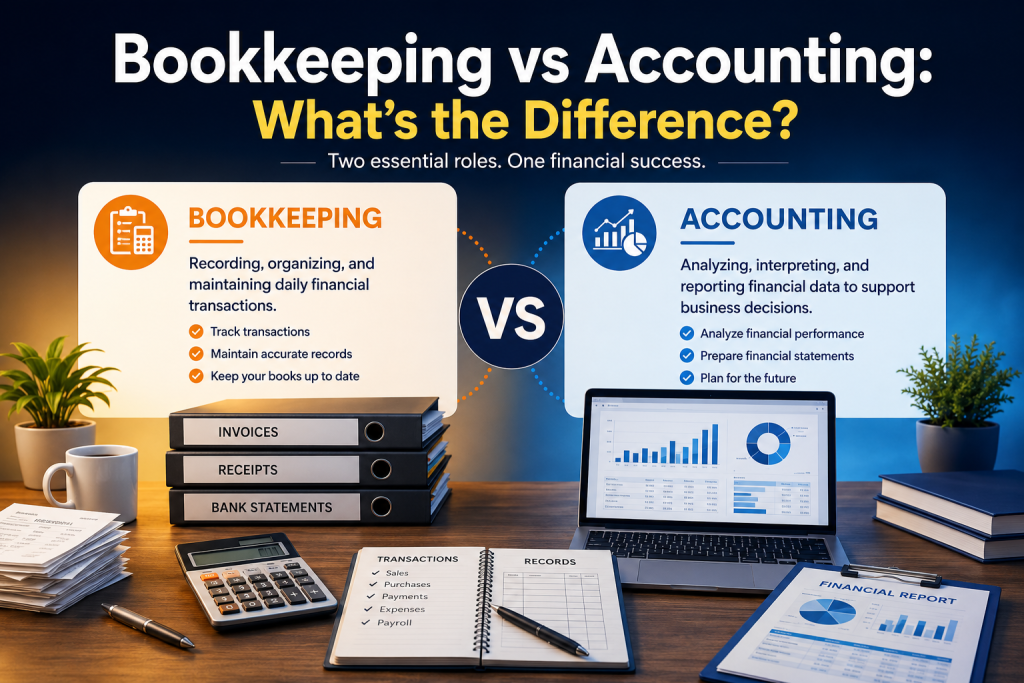
Bookkeeping is the process of recording, organizing, and maintaining a company’s daily financial transactions. Every sale, purchase, payment, invoice, payroll transaction, and business expense must be accurately documented. The primary goal of bookkeeping is to ensure that financial records remain complete, accurate, and up to date.
Bookkeepers are responsible for maintaining the financial data that businesses rely on every day. Their work includes recording income and expenses, reconciling bank accounts, managing accounts payable and receivable, categorizing transactions, processing payroll information, and maintaining organized financial records.
Without consistent bookkeeping, businesses often struggle with missing financial information, inaccurate reports, delayed tax preparation, and poor financial visibility.
What Is Accounting?
Accounting goes beyond recording financial information. It focuses on interpreting, analyzing, and reporting financial data to help business owners understand their company’s financial performance.
Accountants use the organized financial records created through bookkeeping to prepare financial statements, analyze profitability, identify trends, calculate taxes, create budgets, and provide strategic financial advice.
Rather than focusing on daily transaction management, accounting helps answer important business questions such as:
How profitable is the business?
Is cash flow improving or declining?
Can the company afford to expand?
How can taxes be reduced legally?
What financial risks should management address?
Accounting transforms financial data into valuable business intelligence that supports informed decision-making.
The Primary Difference Between Bookkeeping and Accounting
The biggest difference lies in the purpose of each function.
Bookkeeping focuses on collecting and organizing financial information. It ensures every financial transaction is accurately recorded.
Accounting focuses on interpreting that information to evaluate financial performance, ensure compliance, and support future planning.
In simple terms, bookkeeping tells you what happened financially, while accounting explains why it happened and what should happen next.
Daily Responsibilities of a Bookkeeper
A professional bookkeeper performs several essential financial tasks that keep business records organized throughout the year.
They record daily sales and expenses, reconcile bank and credit card accounts, track customer payments, manage vendor bills, organize receipts, process payroll entries, maintain the general ledger, and ensure every transaction is categorized correctly.
These ongoing tasks provide businesses with accurate financial records that can be trusted during tax season, audits, or financial planning.
Key Responsibilities of an Accountant
An accountant uses bookkeeping records to evaluate the overall financial health of a business.
Their responsibilities include preparing financial statements, reviewing profit and loss reports, preparing tax returns, identifying tax-saving opportunities, analyzing business performance, forecasting future revenue, preparing budgets, ensuring regulatory compliance, and advising business owners on financial decisions.
Because accounting involves interpretation and analysis, accountants often play a strategic role in helping businesses grow sustainably.
How Bookkeeping and Accounting Work Together
Bookkeeping and accounting are not competing services—they are complementary functions that depend on one another.
Bookkeeping creates clean, accurate financial records throughout the year. Accounting uses those records to prepare reports, analyze business performance, and ensure compliance with tax laws.
If bookkeeping is inaccurate or incomplete, accounting becomes significantly more difficult. Missing transactions, duplicate expenses, or unreconciled bank accounts can lead to incorrect financial statements and costly tax mistakes.
Businesses achieve the best financial outcomes when bookkeeping is performed consistently and accounting is based on reliable financial data.
Why Accurate Bookkeeping Makes Accounting Easier
Accurate bookkeeping simplifies nearly every financial process within a business.
When records are organized properly, accountants spend less time correcting errors and more time providing strategic financial advice. Tax returns can be prepared more efficiently, audits become less stressful, financial reports become more reliable, and business owners gain greater confidence in their financial decisions.
Consistent bookkeeping also helps businesses identify spending patterns, improve cash flow, monitor profitability, and detect financial issues before they become major problems.
Can Small Businesses Handle Both on Their Own?
Many small business owners initially manage their own bookkeeping and accounting. While this may seem cost-effective, it often becomes increasingly difficult as the business grows.
Business owners already manage sales, operations, customer service, marketing, and employee management. Adding financial recordkeeping to their workload can lead to mistakes, missed deadlines, and inaccurate reporting.
Professional bookkeeping services allow business owners to focus on growing their business while ensuring financial records remain accurate and organized. Accountants can then use these records to provide valuable financial guidance and tax planning.
Benefits of Professional Bookkeeping Services
Outsourcing bookkeeping offers significant advantages for businesses of all sizes.
Professional bookkeepers maintain accurate financial records, reduce costly errors, improve cash flow visibility, simplify tax preparation, provide timely financial reports, ensure bank reconciliations are completed regularly, and support better business decision-making.
Clean financial records also create greater confidence when applying for loans, attracting investors, or preparing for business expansion.
When Does Your Business Need an Accountant?
An accountant becomes particularly valuable when your business begins making complex financial decisions.
If you’re preparing taxes, planning for growth, applying for financing, creating budgets, analyzing profitability, or seeking strategies to reduce tax liability, professional accounting services provide insights that extend far beyond basic recordkeeping.
Accountants help businesses understand their financial position and make decisions that support long-term success.
Which One Does Your Business Need?
The truth is that every business needs both bookkeeping and accounting.
Bookkeeping keeps your financial records accurate and organized on a daily basis. Accounting uses those records to evaluate business performance, ensure compliance, and develop financial strategies.
Think of bookkeeping as building a strong financial foundation, while accounting constructs the roadmap for future growth. Without accurate bookkeeping, accounting loses its effectiveness. Without accounting, bookkeeping data remains underutilized.
Businesses that invest in both functions gain better financial visibility, stronger compliance, improved decision-making, and greater opportunities for sustainable growth.
Conclusion
Bookkeeping and accounting may seem similar, but they play very different roles in managing a successful business. Bookkeeping records every financial transaction and ensures your financial data remains accurate. Accounting interprets that information to provide meaningful insights that help your business grow, stay compliant, and make smarter financial decisions.
At LIT Nexus, we help businesses across the United States maintain accurate books, streamline financial processes, and stay prepared for every stage of growth. Whether you need reliable monthly bookkeeping, account reconciliation, financial reporting, or ongoing bookkeeping support, our experienced team is committed to keeping your finances organized so you can focus on running your business with confidence.
Post a comment
Related Posts

What Happens If You Ignore Your Business Finances?
Introduction Running a business involves countless responsibilities. From managing customers and employees to handling sales,…

Why Clean Books Matter During Tax Season
Introduction For many business owners, tax season is one of the most stressful times of…

Bookkeeping Tips for Law Firms
Introduction Running a successful law firm requires more than delivering exceptional legal services. Behind every…