Demos
 Colors
 Docs
 Support







Introduction
Many business owners use the terms bookkeeping and accounting interchangeably, assuming they refer to the same function. While both are essential parts of managing a business’s finances, they serve different purposes and involve different responsibilities. Understanding the distinction between bookkeeping and accounting can help business owners make better financial decisions, maintain accurate records, and ensure long-term business success.
Whether you own a startup, a small business, or a growing company, both bookkeeping and accounting play vital roles in keeping your finances organized and your business compliant. Bookkeeping provides the foundation by recording financial transactions, while accounting transforms that financial data into meaningful insights that guide strategic decisions.
Knowing how these two functions work together can help you determine the right financial support your business needs at each stage of growth.
What Is Bookkeeping?
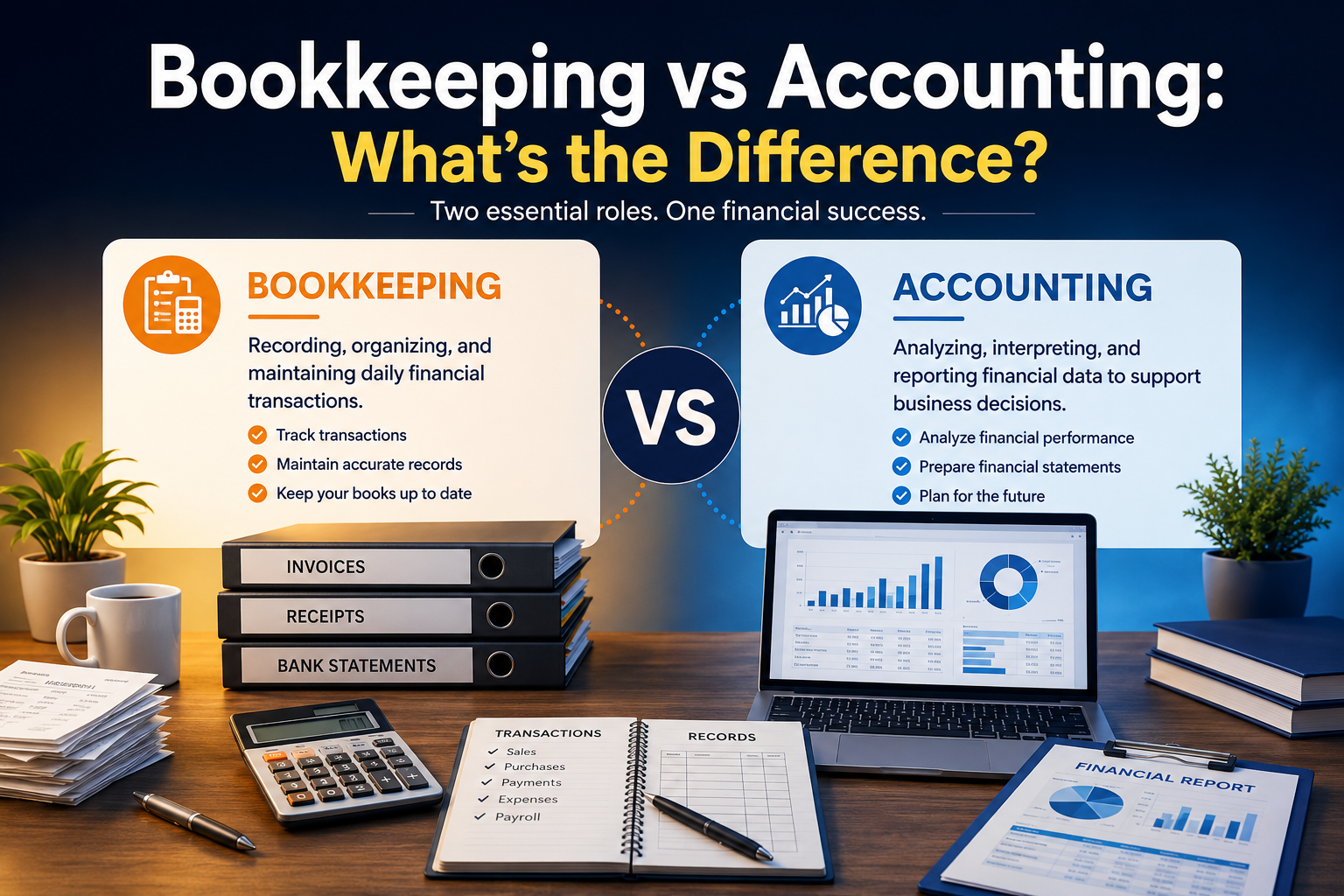
Bookkeeping is the process of recording and organizing a business’s daily financial transactions. It involves maintaining accurate records of income, expenses, purchases, sales, invoices, receipts, payroll, and bank transactions.
The primary goal of bookkeeping is to ensure that every financial activity is properly documented and categorized. These records create a complete financial history that can be used for reporting, tax preparation, and business analysis.
Bookkeeping is an ongoing process that requires consistency and attention to detail. Accurate bookkeeping ensures that financial information remains current and reliable throughout the year.
What Does a Bookkeeper Do?
A professional bookkeeper manages the day-to-day financial records of a business.
Typical bookkeeping responsibilities include recording financial transactions, reconciling bank accounts, managing accounts payable and accounts receivable, processing invoices, organizing receipts, maintaining payroll records, tracking business expenses, and preparing basic financial reports.
Bookkeepers also ensure that financial records remain accurate, organized, and ready for review by accountants or business owners.
Without proper bookkeeping, businesses often struggle with inaccurate financial information, cash flow issues, and unnecessary stress during tax season.
What Is Accounting?
Accounting is the process of analyzing, interpreting, and reporting financial information based on the records maintained through bookkeeping.
Rather than focusing on daily transaction recording, accounting examines the financial data to evaluate business performance, measure profitability, prepare tax returns, forecast future growth, and support strategic decision-making.
Accounting helps business owners understand the overall financial health of their company by converting financial records into meaningful reports and actionable insights.
It plays a crucial role in long-term financial planning and business management.
What Does an Accountant Do?
An accountant uses the information prepared through bookkeeping to perform more advanced financial tasks.
These responsibilities often include preparing financial statements, analyzing business performance, managing tax planning and tax filing, preparing budgets, forecasting future financial performance, ensuring regulatory compliance, advising business owners on financial strategies, and identifying opportunities to improve profitability.
Accountants help businesses understand where they stand financially and what actions should be taken to achieve future goals.
Their work supports informed decision-making and long-term financial success.
The Primary Difference Between Bookkeeping and Accounting
The biggest difference between bookkeeping and accounting lies in their purpose.
Bookkeeping focuses on recording financial information accurately and consistently. Every transaction is entered, categorized, and organized to create reliable financial records.
Accounting begins after bookkeeping has been completed. Accountants use those financial records to prepare reports, interpret financial performance, identify trends, calculate taxes, and provide recommendations that support business growth.
Simply put, bookkeeping answers the question of what happened financially, while accounting explains why it happened and what it means for the future.
How Bookkeeping and Accounting Work Together
Bookkeeping and accounting are closely connected and depend on one another.
Without accurate bookkeeping, accountants cannot prepare reliable financial reports or provide meaningful business advice. Likewise, bookkeeping alone cannot provide the strategic insights that businesses need to grow.
When both functions work together, businesses benefit from organized financial records, accurate reporting, improved cash flow management, better budgeting, informed decision-making, and simplified tax preparation.
Strong bookkeeping creates the foundation upon which effective accounting is built.
Why Both Are Important for Small Businesses
Many small business owners initially attempt to manage both bookkeeping and accounting on their own.
As the business grows, however, financial transactions become more complex, making it increasingly difficult to maintain accuracy while also managing daily operations.
Accurate bookkeeping ensures that financial records remain organized, while professional accounting helps business owners understand profitability, reduce financial risks, optimize taxes, and plan for future expansion.
Businesses that invest in both bookkeeping and accounting are often better prepared to navigate challenges and seize growth opportunities.
Common Misconceptions
One of the most common misconceptions is that hiring an accountant eliminates the need for bookkeeping.
In reality, accountants rely on accurate bookkeeping to perform their work effectively. If bookkeeping records are incomplete or inaccurate, accountants must first spend valuable time correcting financial data before they can prepare reports or tax returns.
Another misconception is that bookkeeping is only necessary during tax season.
Effective bookkeeping should be maintained throughout the year to ensure accurate financial reporting, healthy cash flow, and timely decision-making.
Consistent bookkeeping reduces stress and prevents costly mistakes.
Which Service Does Your Business Need?
The answer depends on your business’s current stage and financial requirements.
Every business needs bookkeeping because every business generates financial transactions that must be recorded accurately.
As businesses grow, accounting becomes increasingly important for financial planning, tax compliance, budgeting, forecasting, and strategic decision-making.
Most successful businesses benefit from having both professional bookkeeping and accounting support working together throughout the year.
This combination provides financial accuracy while also delivering valuable business insights.
Benefits of Professional Bookkeeping and Accounting Services
Working with experienced financial professionals offers numerous advantages.
Professional bookkeeping ensures accurate transaction recording, organized financial records, timely bank reconciliations, payroll accuracy, and reliable monthly reports.
Professional accounting adds financial analysis, tax planning, budgeting, compliance management, and strategic guidance that helps businesses improve profitability and make informed decisions.
Outsourcing these services also saves valuable time, reduces administrative workload, minimizes costly errors, and allows business owners to focus on serving customers and growing their businesses.
Conclusion
Although bookkeeping and accounting are closely related, they perform distinct roles within every successful business. Bookkeeping focuses on recording and organizing financial transactions, while accounting analyzes that information to provide meaningful financial insights and strategic guidance.
Neither function is more important than the other. Instead, they complement each other by creating a complete financial management system that supports business growth, compliance, and long-term success.
Whether you are launching a startup or managing an established company, investing in accurate bookkeeping and professional accounting services will help you maintain financial clarity, improve decision-making, simplify tax preparation, and build a stronger foundation for future growth.
Post a comment
Related Posts

What Happens If You Ignore Your Business Finances?
Introduction Running a business involves countless responsibilities. From managing customers and employees to handling sales,…
Bookkeeping vs. Accounting: What’s the Difference?
Managing your business finances is one of the most important responsibilities of being a business…

Why Clean Books Matter During Tax Season
Introduction For many business owners, tax season is one of the most stressful times of…
Bookkeeping Tips for Law Firms
Introduction Running a successful law firm requires more than delivering exceptional legal services. Behind every…